
AI is changing the work of design studios, generating new possibilities and speeding up the design process exponentially. But are design teams ready for the implications—both organizational and human?
AI can now generate near-infinite variations of product design ideas, features, and configurations. This is a genuine creative gain. Yet the organizational and human costs of fully integrating AI into design are rising.
On the organizational level, the historical bottleneck in product design has moved from idea generation to decision making, with designers attempting to wade through the morass of potential outputs. Meanwhile, rather than reducing design complexity, AI is increasing it, as more dimensions become AI-addressable. Young designers are not learning the skills they need to make the best decisions or maturing their professional identity through the creative process. And it’s becoming more difficult to build trust in the ultimate results when the way they were achieved is opaque.
On the human level, designers are finding their psychological needs disrupted, even as they lose command of their skills and ownership of their decisions. The results have an impact beyond the designers themselves, often resulting in confirmation bias and automation bias, both conditions in which design quality degrades.
Despite these issues, we do not recommend slowing the incorporation of AI into the design process. Instead, design leaders should change the way they engage with AI in three key areas:
- Focus AI on structuring the inputs to support good decision-making
- Use tools and applications that are high-value and psychologically safe
- Spend more time validating and user-testing the outputs
The design leaders who thrive will not be the ones who produce the most, but the ones who make the best decisions—and design the conditions in which good decisions become possible.
Creative gain and the possibilities of AI
Design has always operated under conditions of creative scarcity, with time, skilled labor, and tooling all constraining the number of options that reached the decision table. In the past, designers worked “at the speed of tooling,” that is, the time it took them to sketch, model, create a prototype, and iterate. Good ideas waited for the hands to catch up.
That constraint has gone. AI now allows designers to work at something closer to the speed of thought. The latency between conceiving an option and seeing it rendered has collapsed toward zero. A brief that once took a team three weeks to explore visually, for example, can be exhausted in an afternoon. This is not hyperbole: it is the working reality of design studios today.
The creative gains are real. Rapid-concept exploration that was previously impractical is now routine. Variant generation across materials, forms, and configurations happens in parallel rather than in sequence. Designers can run brand-system stress-testing against dozens of configurations before a single part is manufactured. Pre-prototype evaluation against user-need criteria is possible earlier than ever.
Acknowledging the organizational costs
While the gains are significant, the challenges that emerge in AI-enabled design environments are predictable, and they are already appearing in practice.
Volume.
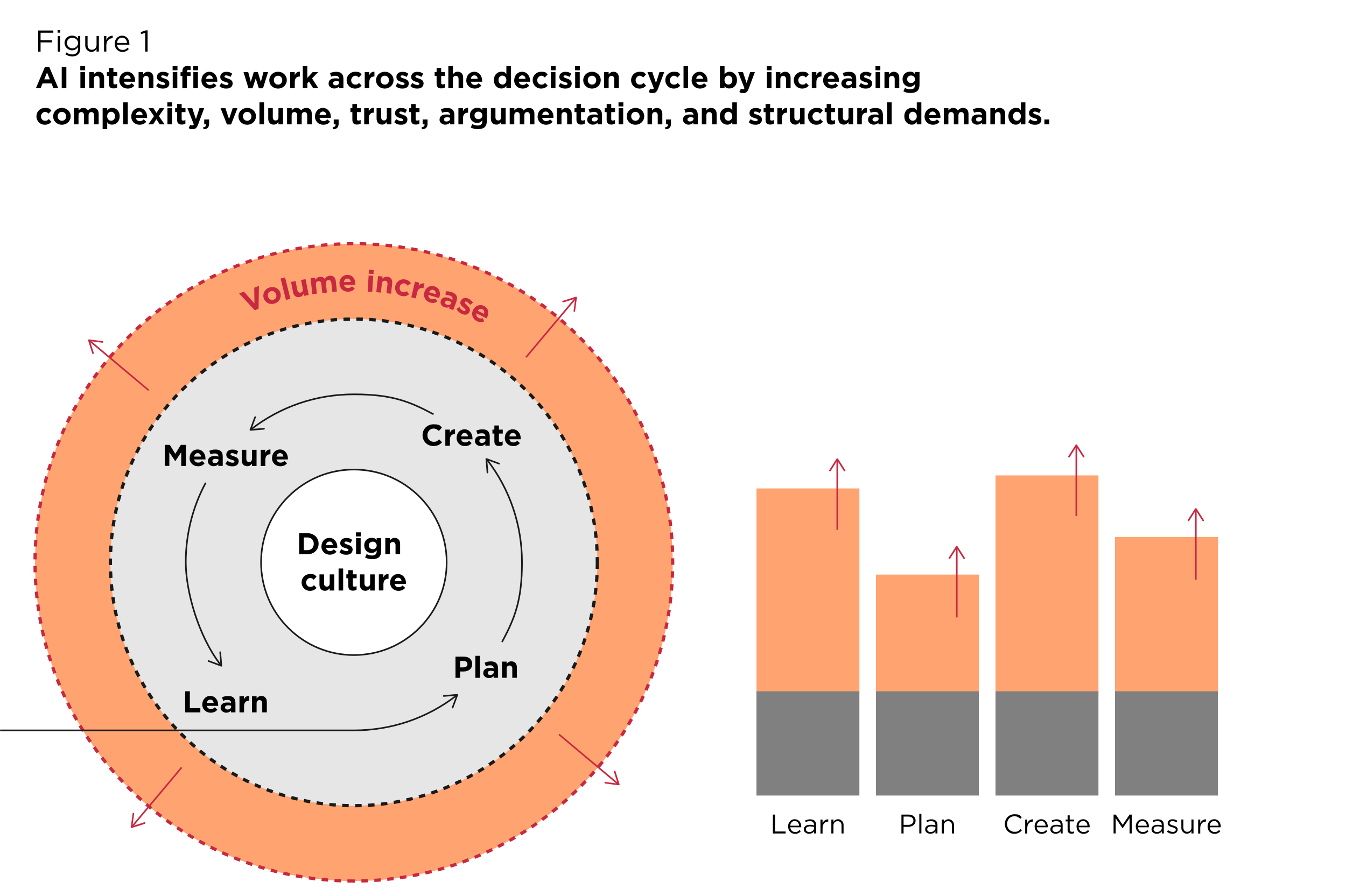
The moment that execution ceased to be the constraint, a new bottleneck took its place, caused by the growing queue of options that designers do not have the time or the criteria to assess rigorously. Design teams simply cannot evaluate what AI produces fast enough. This shift, from execution scarcity to judgment scarcity, should be a focus for every design organization.
Complexity.
Counter to the common assumption that AI reduces complexity, we find that it tends to intensify the work. |*1 More dimensions become AI-addressable simultaneously, including trend data, behavioral insights, market dynamics, regulatory landscape, and brand fit. As a result, the design field boundary blurs, and projects grow in scope rather than shrinking in cost.
Experience.
Junior designers tend to lack the accumulated judgment to curate AI output with confidence. The old process helped build that judgment gradually, through repetitive efforts against real constraints. AI removes the repetition; it also removes the constraints that made the repetition instructive.
Trust and argumentation.
When a synthetic persona (an AI-generated consumer profile that simulates real user behavior) or a market-sizing model produces a result that looks authoritative but cannot be traced to its sources, it becomes unclear how much to trust the output. Worse, when a design decision is generated at speed, the human who selects it may not be able to articulate why the decision was made or trace it back to its sources. In client relationships, cross-functional teams, and leadership reviews, the ability to explain a decision is not optional; it is the mechanism by which trust is built and held.
Structural collapse.
When AI is in the loop, the question of who owns a decision also becomes unclear. The structures that most design organizations use to allocate responsibility were built for a world where the people in the room also produced the work. That clarity has dissolved.
*1 | Ranganathan & Yel, “AI Doesn’t Reduce Work—It Intensifies It,” Harvard Business Review, February 2025.
Understanding the additional human costs
Creative scarcity had an effect in the past that is rarely discussed: it structured how designers developed and maintained their professional identity: the skills, knowledge, and understanding inherent to their individual design practice. The full input into the decisions of these experienced practitioners, including UX research, market analysis, brand strategy, portfolio positioning, product strategy, technical possibilities, and trend analysis, was not simply methodology. It was the scaffolding on which they climbed toward conviction.
Working through frameworks and approaches such as the Kano Model; morphological canvases, or frameworks; multi-criteria decision frameworks; and user evaluations to understand customer needs and product possibilities, designers built and demonstrated expert-level command of the required skills.
“It’s not just a methodology, nor a decision framework. This is about maintaining command and ownership.”
– Director of Design
Kees Dorst and Nigel Cross showed in their foundational research on design expertise |*2 that problems and solutions co-evolve in expert practice. Designers do not simply solve a given problem; they reframe the problem and the solution simultaneously through a process that requires deep contextual knowledge and trained judgment. That reframing capacity, and the confidence to exercise it under uncertainty, are what the old process built over years. It was not separable from the work. It was the work.
What AI is now disrupting is therefore not merely an old set of tools or workflows. It is the mechanism by which design professionals maintained command of their skills and ownership over their decisions.
Losing that mechanism has costs that go beyond productivity. There is a psychological dimension of the transition to AI design; this dimension is the most underexamined part of the current conversation. To find out more, we interviewed 25 senior designers across Europe working in the disciplines of industrial and interaction design to obtain their perspectives. Their descriptions of their own experience of AI-assisted work include the following:
“Speed from intent to result skips the most important part—the thinking in between.”
“Going fast from idea to result means missing the journey where the idea becomes mine.”
“When the process disappears, so does the sense of achievement.”
“There’s no joy in a result you didn’t earn through the struggle.”
These are not complaints about productivity. These are descriptions of what we term “psychological need disruption.” It results from competence undermined when the tool produces in seconds what took years to command; autonomy threatened when AI generates options the designer did not initiate or quietly makes decisions the designer once made consciously; and self-worth eroded when the journey from problem to solution, through which the design becomes truly their own, is compressed out of existence (Figure 1).
Some of the natural human responses to this disruption are predictable, including confirmation bias—favoring AI outputs that match existing expectations—and automation bias—deferring to AI outputs because the machine must know better. Neither is a character failing. Rather, both are rational psychological defense mechanisms against threats to competence and autonomy.
This is a leadership problem, not a wellness footnote. The quality of judgment in a design organization is a direct function of the conditions in which that judgment is exercised.
*2 | Dorst & Cross, “Creativity in the design process: co-evolution of problem–solution,” Design Studies, Vol. 22, Issue 5, 2001.
IV. Three levels of response
The leadership response to these issues is not to slow AI adoption or defend old processes for their own sake. On the organizational side, the response is to engage with AI at three distinct levels, each requiring a different kind of leadership attention.
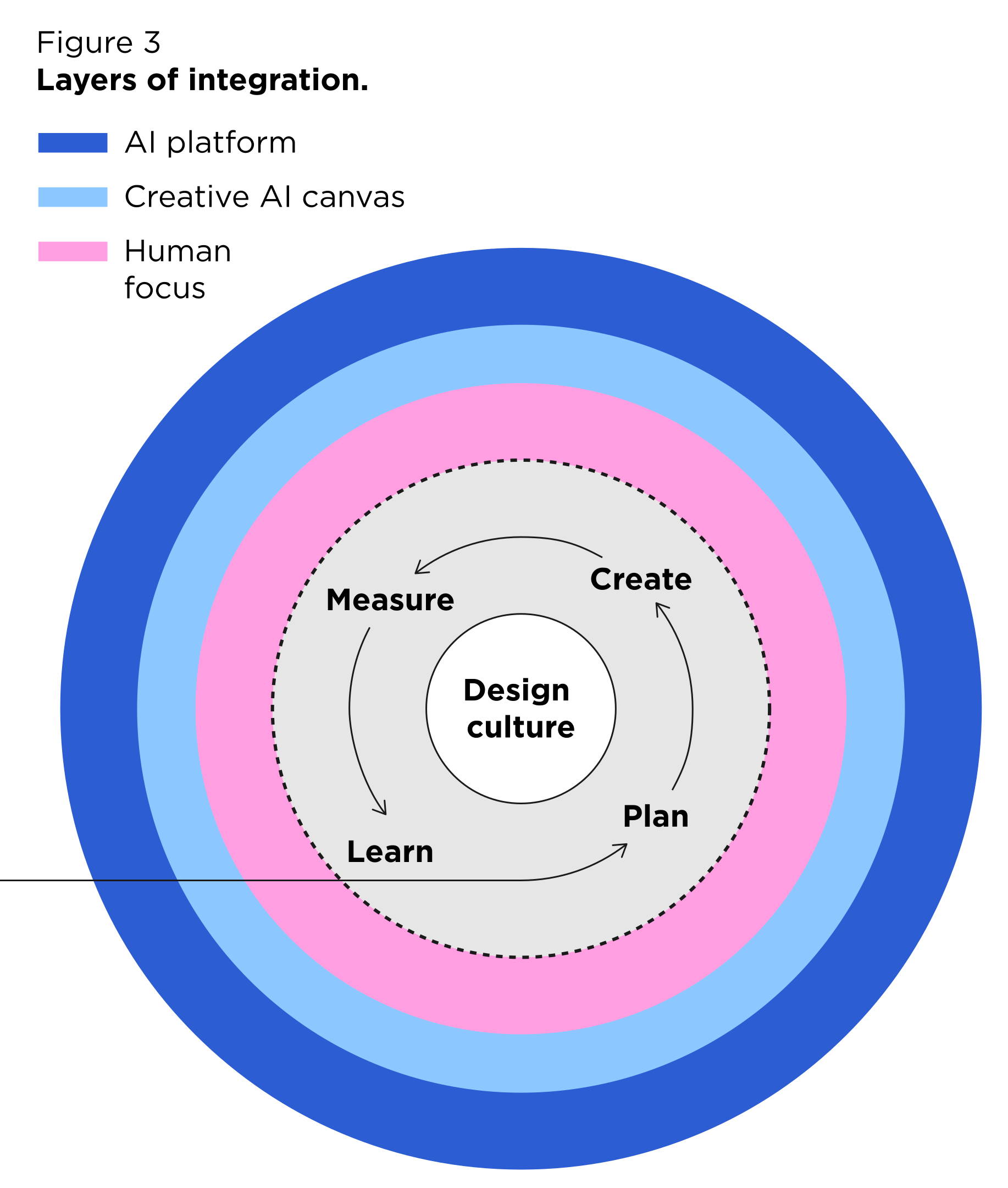
The AI platform structures the inputs
The most productive use of AI in design practice is not generative; it’s analytical. AI excels at structuring the inputs that used to live in designers’ heads or in research reports that no one had time to fully digest.
The canvases that have proved most useful in our own practice map directly to the old decision input stack:
- AI agents are used to interview people more efficiently, and synthetic persona research augments those interviews.
- Competitive-landscape analysis replaces manually assembled market reviews.
- Value proposition canvases, business model analysis, and market-sizing outputs replace the strategic framing that once consumed the early weeks of every project.
- Design for manufacturing and supply chain assessment, previously requiring extensive specialist involvement, becomes a first-pass tool available at the concept stage.
The value of framing these outputs as “canvases” rather than AI agents is not merely semantic. A canvas is a structured surface where human judgment can land. It does not decide; it organizes the conditions under which a decision can be made well. The designer working with an AI-structured canvas is still making the call on persona validity, strategic fit, and brand alignment. The AI structures the input; the designer owns the conclusion.
The AI meets designers where they work
At the creative level, AI should meet designers in the act of making. Style fingerprinting, clustering, visualization, AI participation in design workshops, and storyboarding are among the applications that have proved both high-value and psychologically safe in practice: they accelerate without replacing, and they keep the designer’s hand meaningfully in the task.
The tools that work well tend to create value quickly, at high accuracy, while supporting the designer’s sense of command over the project. The tools that fail tend to produce outputs that look finished, but the thinking behind them isn’t sound. This creative layer has a paradox at its center: AI fosters creativity precisely when designers use it to create more and faster, not to allow them to think less.
Protect human understanding
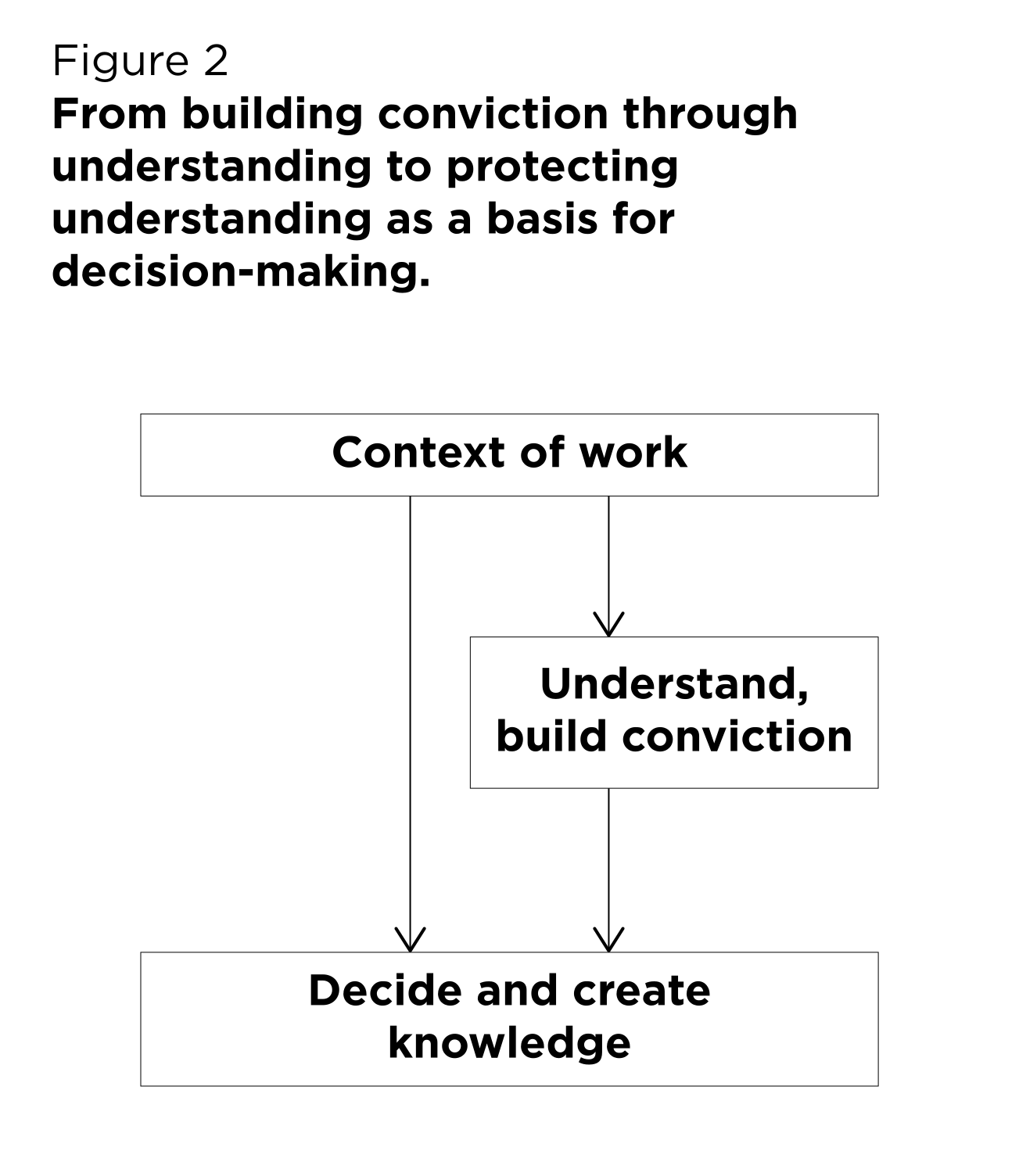
The deepest change required is in the way design organizations think about knowledge and conviction. The old logic ran like this: through understanding, we build conviction, and through conviction, we decide. Research, synthesis, and analysis were the path to confidence.
AI can short-circuit the “understanding” step. It can thus produce outputs that look like conclusions before the team has done the work of comprehension. The leader’s job should be to ensure that this short circuit does not happen and that speed at the surface does not come at the cost of the depth below it (See Figure 2).
For design teams, this means spending less time creating and more time validating. User testing and qualitative research, already underweighted in a fast-moving design practice, become non-negotiable when AI has compressed the concept phase. The outputs are more tangible and practical earlier. However, that is an advantage only if someone is checking them against genuine human needs rather than accepting plausibility as proof.
V. What design leaders should do now
Three practical commitments follow from this analysis.
Make the frame explicit before generation starts. In the old process, the strategic frame emerged gradually through research and analysis. If the designer is unprepared, AI reverses that sequence: it can generate concepts before the frame has been agreed. This is the single most common source of wasted effort in accelerated design environments, in our experience. The strategic frame, or the problem we are solving, for whom, within what constraints, and toward what long-term position, is a first-class artefact.
Treat criteria as an essential input. When there are six options on the table, an experienced designer can scan and understand which one to recommend. When there are six hundred, knowing becomes almost indistinguishable from guessing. Criteria must therefore be made explicit, structured, and shared before the evaluation begins. The move from implicit craft to explicit canvas, from judgment carried in individual heads to judgment made visible and challengeable by the whole team, is the core cultural shift that this moment requires.
Build the conditions for honest judgment. Psychological safety, that is, the confidence that one can challenge an output, question a direction, or say “none of these” without professional penalty, is a cultural precondition for good decision-making. In an AI-enabled environment, where output is generated quickly and looks polished from the start, the pressure to defer rather than challenge is acute. Leaders who want their teams to exercise genuine judgment must actively create the conditions for it.
The optimal position is to acknowledge the issue rather than paper over it. Leaders should therefore introduce explainability as a design principal, making the reasoning behind design decisions visible, structured, and challengeable across the entire design team.
Designing with deeper thought
There is a temptation when writing about the disruption that AI brings to creative practice to frame it as loss: the craft is threatened, the identity is at risk, the years of accumulated skill are partly obsolete. All of that is true. But the framing of loss is misleading. Several conditions had already made design leadership difficult before AI, including the need to hold to a strategic direction under commercial pressure, align multiple stakeholders around a coherent vision, and make confident decisions in the presence of incomplete information. AI simply intensifies these conditions: what was already hard is becoming harder, moving faster, and gaining consequence.
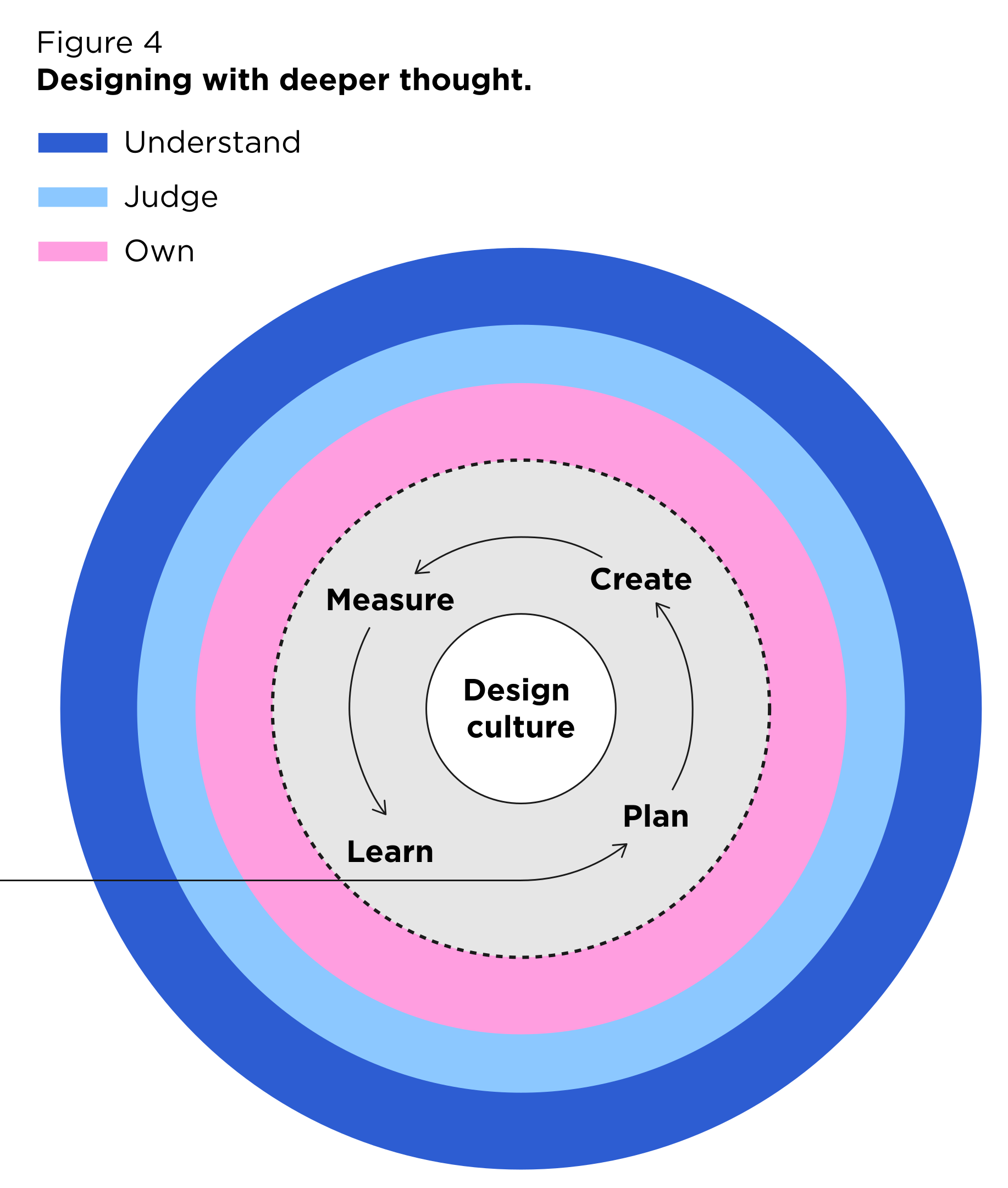
The design leaders who navigate this well will share three qualities.
- They will understand the territory: not just the AI tools, but the human dynamics, the failure modes, and the psychological costs.
- They will judge rigorously: not just selecting from what AI produces but interrogating it and knowing the difference between an option that merely looks right and one that is.
- They will own the conclusions: maintaining accountability for decisions that are increasingly collaborative, distributed, and difficult to trace to a single human source.
These are not new virtues. They are old ones that the current moment makes newly urgent.