Why the best digital ecosystems reveal the choices that matter
The promise of a digital ecosystem is simple: products, interfaces, services and data should work together as one experience. The risk is that seamlessness becomes a goal in itself. When every transition disappears, users can lose sight of what moved, what changed and who decided. The answer is not more friction. It is better designed seams.
A product once had a visible edge. The controls belonged to the object, the service began after purchase and the information stayed close to the device. Today, a product can continue through an app, a cloud platform, a support service, a stream of data and a growing set of connected devices. The interface in front of the user is no longer the whole product. It is one view into a larger system.
The product has become a living state
The contemporary product can be compared to a playlist that keeps growing or a shopping basket that has not yet reached a final state. What appears on one device is temporary. The product continues as information is synchronized, reinterpreted or made available somewhere else.
This changes where designers should look for the product boundary. The important edge is no longer the casing or the screen. It is the handover between a device and an app, between an app and the cloud, between live data and a service, or between one person and the next. These transitions determine whether the experience feels coherent or fragmented.
Fragmentation is already a defining condition inside many organizations. Salesforce reports that the average enterprise manages 897 applications, while only 29 percent are integrated. A more polished interface cannot solve that problem on its own. If the relationships between existing systems remain unclear, another interface risks becoming another island.
Seamless outcomes need seamful decisions
Digital design has spent years pursuing seamlessness. The ambition is understandable. People should be able to continue a task across touchpoints without repeatedly orienting themselves, entering the same information or learning a new logic.
Yet seamlessness can become misleading when it hides transitions that people need to understand. Data does not simply travel from one device to another. It is selected, translated and sometimes omitted. A notification may summarize a much larger dataset. A service may interpret a machine state before presenting a recommendation. An AI agent may act across several applications without showing every step.
This is where the idea of seamful design becomes useful. Seamful does not mean awkward or disconnected. It means treating the boundary as a design decision. The experience can flow smoothly while still making clear what information is moving, why it matters and what the user can control.
Consider a health ecosystem that combines information from a watch, a sleep tracker, a nutrition service and a home environment. Passing every available data point into one interface would not create clarity. The system needs to decide what is relevant to the current task, explain the basis of its conclusion and allow the user to inspect or change the selection. The flow should feel seamless. The handling of the data should remain seamful.
The distinction becomes especially important where trust, safety or consent is involved. A well-designed seam can confirm that a handover took place, explain why a recommendation changed, or show which system is responsible for the next action. The goal is not to expose every technical detail. It is to preserve the moments in which understanding affects a decision.
Design rules now carry the brand
As products extend across devices and services, the work of digital design shifts from defining individual screens to establishing rules for an entire ecosystem. Those rules determine how the system behaves, how it communicates and how it remains recognizable as the context changes.
A digital brand experience reaches far beyond typography and color. It includes the tone of a message, the rhythm of an animation, the behavior of a light, a vibration pattern, the priority of an alarm and the moment a push notification appears. Together, these interactions create a language that users learn over time.
The challenge is consistency without uniformity. Shared principles should reduce relearning, but they must leave room for the demands of a specific product, task or environment. A familiar interaction pattern may work across a portfolio, while an alarm in a safety-critical context needs a different hierarchy from a routine service message.
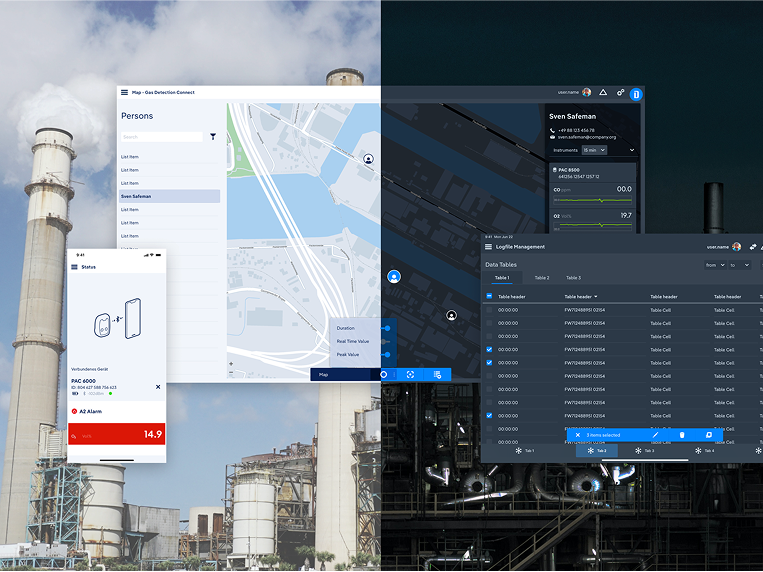
The One Dräger Experience design system shows how this principle can work across a complex organization. The shared system connects Dräger Safety, Medical and Services through common components, interaction principles and brand logic, while remaining adaptable to very different operating situations. It provides a single source of truth without forcing every interface to become the same.
For the business, this shared foundation reduces duplicated design work and repeated decisions. For design and development teams, tokens, components and guidelines make collaboration more direct. For users, familiar behavior supports knowledge transfer and lowers the effort required to move between products. The system creates value because it can be reused, maintained and extended.
The journey should lead the system
When a physical product and its digital ecosystem are developed together, the process can appear to have several possible starting points: the device, the data, the interface or the platform. The complete user experience should lead. The system remains in view, but the first question is what a person is trying to accomplish across the physical and digital parts of the product.
This means treating the interaction with the object, the information on the screen, the synchronization between devices and the use of cloud data as one journey. The design team can then test where existing principles are sufficient and where the ecosystem needs to expand for a new context.
The individual interface still matters. A broad ecosystem cannot compensate for a product that is difficult to operate in the moment. Each touchpoint must provide the best response for its immediate context, while contributing to a journey that continues beyond it. Designing the whole system therefore does not make the screen less important. It makes the relationship between screens more important.
AI turns the ecosystem into an interface
Many companies want their platform to become the central place where devices, data and services meet. That ambition can create value, but it can also turn the ecosystem into a cage. A closed system may provide consistency at first, then become difficult to extend when customers need to connect existing machines, third-party products or established software.
An effective ecosystem understands its own products in detail and creates transparent routes for information to move beyond them. Open interfaces allow external devices to contribute data and allow a product to participate in other platforms. The design task is to make those exchanges understandable and useful.
Openness does not mean that everything should communicate with everything else. That would generate more volume without creating more meaning. The value lies in choosing which information should pass between systems, how it should be translated and what the receiving context needs. Once again, seamless integration depends on seamful decisions.
Success must be measured over time
A screen can be tested at a moment in time. An ecosystem has to remain understandable as products, services and user expectations change. Time is another design dimension: interaction principles may be learned over years, while individual devices and features are updated around them.
This changes how success should be measured. Consistency, fewer errors, faster onboarding and reduced development effort all matter. So do the system's ability to support new services, accept new sources of data and evolve without making familiar tasks harder. A redesign that breaks learned behavior can diminish the value of otherwise excellent physical products.
The strongest ecosystems balance continuity with change. They preserve the principles that help people orient themselves, then expand those principles as new contexts emerge. They also give teams a maintained foundation for development instead of asking each product group to solve the same interaction problems again.
The product and ecosystem rise together
Digital design is not leaving screens behind. It is placing them inside a larger design problem. The interface on a device, the transfer of information, the surrounding services and the rules of the platform now shape one another.
For companies, this means that ecosystem design cannot be treated as a layer added after the physical product is finished. Decisions about data, behavior, interoperability and long-term evolution influence the quality of the product itself. For designers, it means working across visible interactions and invisible structures at the same time.
The best ecosystem does not erase every seam. It ensures that people encounter the right seam at the right moment, with enough context to continue confidently. That is how a connected experience becomes coherent, trustworthy and capable of growing.
Author

Florian works across physical and digital product experiences, design systems and connected ecosystems. His perspective combines industrial design with user interface design and nearly 15 years of work with evolving digital products.